
Advantages of Trimble Trolley Surveys
Advantages of Trimble Trolley Surveys

Trimble GEDO CE 2.0 Railway Surveying System
Precision, Efficiency and Smarter Track Control
In railway construction and maintenance, accurate track measurements are essential to keeping projects on schedule and minimizing costly adjustments. The Trimble GEDO trolley system offers an efficient solution for collecting precise railway geometry data, supporting construction, alignment verification, and quality control while reducing fieldwork time and potential operational disruptions.
Integrated Trimble GEDO Systems for Track Survey and Control
The Trimble GEDO CE 2.0 trolley supports specialized surveying applications through systems such as GEDO Rec for geodetic track surveys, GEDO Vorsys for track alignment and tamping preparation, and GEDO IMS for high-productivity measurements using inertial technology.
Combined with GEDO Office software, survey data can be processed and compared with design specifications to identify deviations, support corrective actions, and generate reliable documentation for engineering and construction teams.
When Can This Technology Make a Difference?
Whether planning new railway construction, upgrading existing tracks, or verifying alignment before project delivery, accurate and timely measurements can help prevent delays, improve quality control, and support more informed engineering decisions.
The system's flexibility and efficient field operation make it particularly valuable for projects where measurement accuracy, limited track access, and construction deadlines are critical.
Discover how our railway surveying services can support your project's specific requirements.
When Surveying Pillars Fail
When pilar fails?
A Hidden Risk to Measurement Accuracy
A Hidden Risk to Measurement Accuracy
Why Stable Surveying Control Points Matter?
Even the most advanced surveying equipment cannot deliver reliable results without a stable reference point. In major infrastructure projects, surveying pillars provide the foundation for precise measurements using total stations and other geodetic instruments. However, poor construction, inadequate foundations, or structural instability can introduce movement and compromise measurement accuracy.
Small Movements, Significant Consequences
In railway construction, tunneling, bridges, and other infrastructure projects requiring millimeter-level precision, even minor movement in a surveying pillar can affect the reliability of the control network.
These errors may lead to alignment discrepancies, repeated measurements, costly corrections, and delays during construction.
A Real Example of an Unstable Surveying Pillar
The video demonstrates a surveying pillar with noticeable instability, illustrating how an apparently solid structure may fail to provide the stability required for high-precision measurements.
This example highlights why inspecting surveying monuments and verifying geodetic control networks should be part of quality assurance before critical measurement activities begin.
Precision Begins with a Reliable Foundation
At Miami Coservice, we understand that reliable surveying depends on more than sophisticated instruments. Our experience in geodetic control networks, precision surveying, and infrastructure projects helps identify potential measurement risks before they affect construction activities.
Is your project's surveying control network providing the stability and accuracy your engineering team requires?
Our team can help evaluate surveying control points and support reliable measurements throughout your project.
The Future of Railway Surveying: How Technology is Transforming the Industry
The Future of Railway Surveying:
How Technology is Transforming the Industry
Combining Engineering Expertise with Advanced Technology
Railway infrastructure projects demand precision, efficiency, and reliable information. Today, technologies such as 3D laser scanning, automated track surveying systems, and digital monitoring are transforming how engineers collect, analyze, and manage surveying data.
Rather than replacing traditional surveying methods, these technologies complement established engineering practices, providing new opportunities to improve productivity, accuracy, and project coordination.
Traditional Methods and Modern Solutions
Conventional surveying techniques remain essential in many railway applications. However, projects involving extensive track networks, complex structures, or limited access windows can present challenges when relying primarily on manual measurements.
Modern surveying solutions help address these challenges by accelerating data collection, improving documentation, and reducing the need for repeated field measurements.
Technology That Makes a Difference
3D Laser Scanning and Point Clouds
Capture detailed three-dimensional information about railway corridors, tunnels, stations, and surrounding structures. These datasets support engineering analysis, clearance assessments, as-built documentation, and infrastructure planning.
Automated Railway Surveying Systems
Specialized equipment such as the Trimble GEDO trolley provides efficient track geometry measurements, supporting alignment verification, construction quality control, and maintenance activities.
Digital Monitoring and Data Analysis
Monitoring technologies help engineering teams identify changes in infrastructure conditions, evaluate potential risks, and make informed decisions throughout the project lifecycle.
Beyond Technology: The Value of Experience
Advanced equipment alone does not guarantee successful results. Proper surveying methodology, reliable control networks, accurate data processing, and experienced professionals remain essential.
The greatest benefits emerge when modern technology is combined with strong technical expertise and a clear understanding of project requirements.
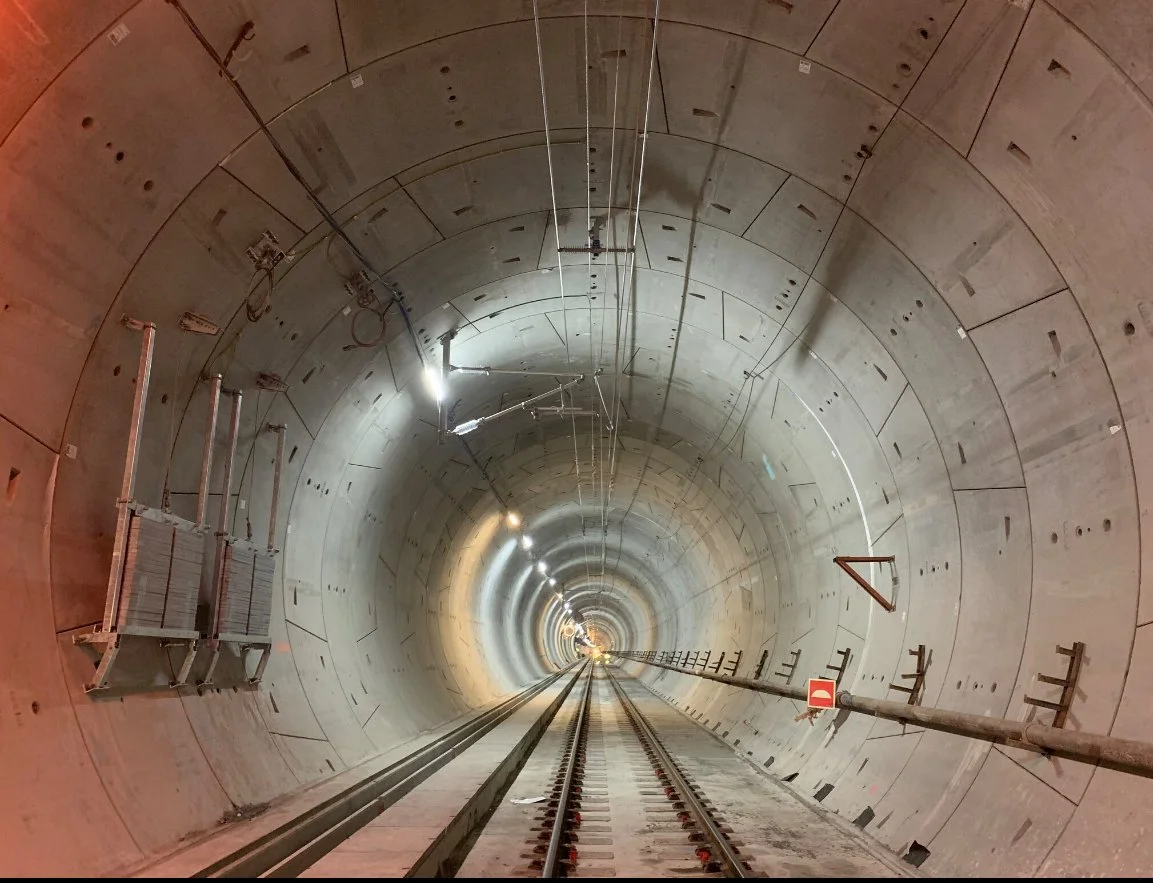
Railway tunnel infrastructure during construction, highlighting the importance of precision surveying and advanced engineering technologies.